

“Root intrusion is the single most destructive element facing sewer authorities.”
Thirty five years on and the problem is still as pervasive, but a solution is at hand with the Sanafoam Vaporooter II foaming sewer root inhibitor.
To understand how to control root intrusion into sewers we need to know why and how roots enter sewer pipes. Roots grow one cell at a time by splitting and growing in a process called hydrotropism. The hairs that form on the roots as they grow absorb moisture and nutrients. As the roots grow the meristem is coated by a root cap that protects the root. The best environment for roots to grow in is cultivated soil where warmth, nutrients and moisture are abundant and easily accessible – which is pretty much the definition of a sewer pipe. Sewer pipes are laid in the ground and back filled with fine stone and soil. The effluent in the pipe is warmer than soil outside the pipe which creates condensation on the outside of the pipe near cracks and imperfections in the pipe. The condensation vapours travel to the surface, leading roots to the pipe defects and into the pipe. Inside the pipe there is an abundance of nutrients and moisture available for the roots and they will thrive in this nutrient rich environment.
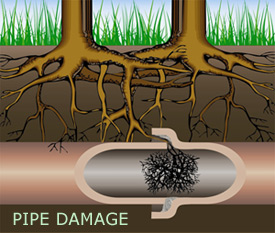

Conditions that encourage root growth
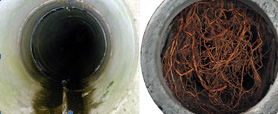
The process of cutting roots is a reactive response to drain blockages or maintenance. It will deliver a good initial result by removing some roots from the line and clearing a blockage. However this very process further encourages root regrowth. Each time roots are cut they respond by regrowing thicker and faster, similar to pruning a hedge. The aggressive nature of the cutting process will also damage the condition of the pipe and will inevitably result in costly rehabilitation or replacement.

Scientific research

The trial was extensive and exhaustive and included the building and use of a trial glass sewer line. Initially a flood application method was adopted and worked well. This method required plugging of the line. As a result entry into the sewer and customer service issues would arise. In 1972, Fred Horne, who had actively participated in the UC Davis trials, went on to develop a more effective delivery method for the herbicides than line soaking or spraying to ensure maximum contact with the root mass. Fred developed the foaming method and the foam formulation used today in Sanafoam Vaporooter II foaming sewer root inhibitor. The foam allowed the UC Davis selected herbicides to be applied to the sewer without plugging the line or the need to enter a manhole. A patented two stage nozzle works as a traditional jetter nozzle to jet upstream cleaning the roots. When jet pressure stops the spring releases to allow foam to be generated as the hose is retrieved at specific rate back to the downstream manhole. This nozzle eliminates any need to enter a manhole. The foam will dissipate after two to three hours.
Vaporooter is registered with the APVMA to control root growth in sewers. The APVMA evaluate chemicals to establish the effect of the chemicals on the environment, licensed applicators and the general public. They detail label specifications including directions of use and warnings.
 Pipes treated with a chemical treatment should be left undisturbed for a period of 6 months to allow for degradation of the organic material in the pipe. It should be the last treatment in the pipe. Other action in the pipe will remove residual herbicides and destroy the effectiveness of the treatment process. Larger roots may remain in the pipe for a period of months or longer as they take time to rot off into the flow. However roots will be dead and appear black and droopy, less likely to catch debris and cause a blockage. After a chemical treatment process a CCTV inspection will identify some remaining roots. You cannot expect a gun barrel clean pipe with your first chemical application. A regular maintenance program to treat and re-treat sewer lines within the guarantee period in the long run will result in a more cost effective and manageable sewer maintenance program and a better performing sewer asset. If your treatment process can achieve an 85 per cent effective kill ratio you will have an effective program which will deliver asset performance results. Re-treatments will raise the performance of the process to 99 per cent effective.
Keeping roots out of the sewer line will reduce the destruction of the pipes that eventually leads to more expensive and evasive solutions such as pipe replacement and relining. The development of a preventative maintenance program for newer sewer lines and a proactive maintenance program for older sewer systems will deliver a better performing sewer asset with less blockages faster flows, greater useful pipe capacity, less overflows and pollution, lower operating and maintenance costs and happy customers.